
Digital payments in Italy are evolving fast, but not uniformly. How Digital Payments evolve across Industries in Italy? While headlines often talk about “the growth of digital payments” as a single trend, the reality on the ground looks very different depending on the vertical you observe. Each industry adopts payment technologies at its own pace, shaped by customer expectations, regulatory pressure, operational complexity, and competitive dynamics.
Understanding these differences is crucial for merchants, agencies, and technology vendors. Payments are no longer a generic infrastructure layer. They are a strategic component of customer experience, conversion, and retention. The merchants who recognize this shift early and adapt their payment strategies accordingly will gain significant competitive advantages in their respective markets.
How Digital Payments evolve across Industries in Italy?
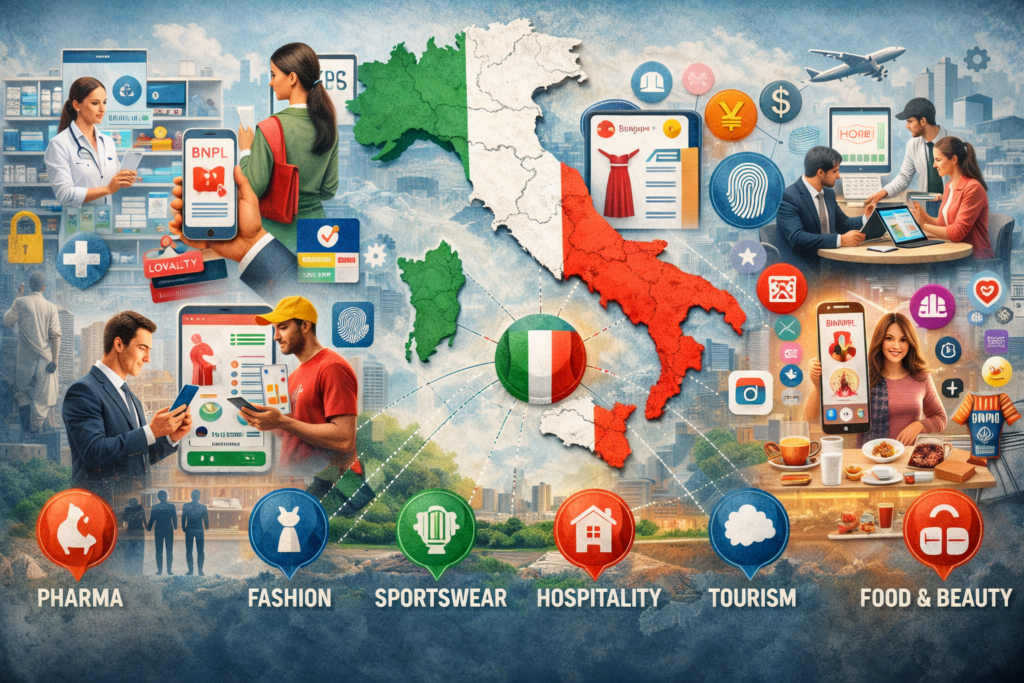
THE PHARMACEUTICAL SECTOR: BALANCING COMPLIANCE WITH CONSUMER EXPECTATIONS
Pharma is a clear example of this complexity. Even in a heavily regulated environment, digital wallets solutions are gaining traction. Security, compliance, and data protection remain non-negotiable, yet consumers increasingly expect the same seamless experience they get in other sectors. The challenge for pharma merchants is balancing frictionless checkout with strict compliance requirements. Those who manage to do so unlock higher conversion without compromising trust.
The pharmaceutical industry faces unique challenges that other verticals don’t encounter. Patient data privacy under GDPR and sector-specific regulations creates additional layers of complexity. Yet, younger consumers purchasing over-the-counter products, supplements, and wellness items online expect instant checkout, saved payment methods, and mobile-first experiences. The gap between regulatory requirements and consumer expectations is narrowing, forcing pharma merchants to innovate within strict boundaries.
Progressive pharma retailers are implementing tokenized payment solutions that maintain compliance while enabling one-click purchases for returning customers. They’re also exploring age verification integrated directly into payment flows, ensuring regulatory compliance without adding unnecessary friction. The most successful players are those who view compliance not as a barrier but as a framework within which innovation must occur.
FASHION: WHERE EMOTION MEETS TRANSACTION
Fashion tells a different story. Here, payments are deeply connected to emotion, impulse, and loyalty. Younger buyers are driving explosive BNPL adoption, while wallets such as Google Pay and Apple Pay are increasingly part of loyalty-driven checkout strategies. Payments are no longer just transactional. They are a lever to improve lifetime value, reduce cart abandonment, and create a smoother repeat purchase journey.
The fashion sector thrives on impulse and aspiration. A consumer scrolling through Instagram might discover a dress they love and want to purchase immediately, but price sensitivity can create hesitation. This is where BNPL solutions have transformed the conversion equation. By enabling customers to split purchases into manageable installments, fashion retailers are capturing sales that would have otherwise been lost.
Moreover, fashion brands are increasingly integrating payment methods with loyalty programs. Satispay, for example, offers cashback opportunities that fashion retailers leverage to encourage repeat purchases. The payment method itself becomes part of the value proposition, not just a means to complete a transaction. Some brands are even creating exclusive payment-linked perks, such as early access to new collections for customers who use specific payment methods or maintain certain purchase patterns.
The data generated through these integrated payment and loyalty systems provides fashion retailers with unprecedented insights into customer behavior, enabling more personalized marketing and inventory management. This creates a virtuous cycle where better payment experiences lead to more data, which enables better experiences, driving higher customer lifetime value.
SPORTSWEAR: SPEED AS A COMPETITIVE ADVANTAGE
Sportswear highlights the importance of speed. During product drops or peak traffic moments, frictionless mobile payments become critical. Local payment methods can significantly influence conversion when seconds matter. A slow or confusing checkout experience directly translates into lost revenue.
The sportswear industry has adopted a drop culture borrowed from streetwear, where limited-edition products are released at specific times, creating intense demand spikes. During these moments, checkout infrastructure must handle massive concurrent traffic while maintaining sub-second response times. Any friction becomes a conversion killer.
Mobile-first payment experiences are essential in this vertical. Many consumers attempt to purchase during drops while on the go, often competing with thousands of other buyers for limited inventory. The difference between securing a coveted item and missing out often comes down to how quickly a payment can be processed. Sportswear retailers are investing heavily in payment orchestration platforms that automatically route transactions to the fastest available processor based on real-time performance metrics.
Additionally, the sportswear sector is exploring biometric authentication integrated with payment flows, enabling customers to complete purchases with fingerprint or face recognition without entering any payment details. This shaves precious seconds off the checkout process, potentially making the difference in high-competition scenarios.
HOSPITALITY: BRIDGING DIGITAL AND PHYSICAL EXPERIENCES
Hospitality has embraced QR payments at scale. Restaurants and hotels increasingly rely on integrated POS and ecommerce systems to deliver a unified guest journey that connects booking, dining, payments, and post-stay engagement. In this vertical, payments act as a bridge between online and offline experiences.
The hospitality sector was accelerated dramatically by pandemic-era contactless payment adoption, but the innovation has continued far beyond necessity. Progressive hotels are now implementing systems where guests can book rooms online, unlock doors with their smartphones, order room service through an app, and check out without ever interacting with front desk staff, all powered by integrated payment systems.
Restaurants are taking similar approaches with QR code-based ordering and payment systems that allow diners to view menus, place orders, split bills, and pay without waiting for service staff. These systems not only improve table turnover rates but also capture valuable data about customer preferences, enabling more personalized experiences on return visits.
The most sophisticated hospitality operators are using payment data to create comprehensive guest profiles that span multiple touchpoints. A hotel might recognize that a guest always orders cappuccino in the morning and proactively offer it, or a restaurant might remember dietary preferences and suggest appropriate menu items. Payment systems have evolved from simple transaction processors to central nervous systems that coordinate the entire customer experience.
TOURISM: GLOBAL PAYMENT INFRASTRUCTURE FOR GLOBAL TRAVELERS
Tourism requires global thinking. Multi-currency acceptance and wallets such as Alipay+ are critical for inbound travelers, especially with Asian tourism rebounding strongly in 2025. Payments here are a matter of accessibility and trust. If travelers cannot pay with familiar methods, conversion drops instantly.
The tourism sector faces a unique challenge: serving customers from dozens of countries, each with distinct payment preferences and expectations. An Italian hotel might receive guests from China, the United States, Germany, and Japan in a single week, each expecting to pay with their preferred method. Supporting this diversity is not optional, it’s essential for competitiveness.
Beyond simply accepting international cards, forward-thinking tourism operators are integrating regional wallet systems like Alipay, WeChat Pay, and various Southeast Asian payment platforms. These integrations signal to international travelers that they’re welcome and understood, building trust before they even arrive. Some destinations are going further, offering real-time currency conversion at checkout so travelers can see prices in their home currency, reducing transaction anxiety.
Dynamic currency conversion, when implemented transparently, can also become a revenue source for tourism operators while providing genuine value to travelers. The key is transparency, travelers should always see both local and converted amounts, along with exchange rates and any fees, enabling informed decisions.
ENTERTAINMENT: MOBILE-FIRST INNOVATION
Entertainment is moving mobile-first. Ticketing platforms are experimenting with tokenized payments, mobile wallets, and embedded upsells such as insurance or merchandise directly at checkout. The goal is reducing friction while increasing average order value.
The entertainment sector, encompassing everything from concerts to sports events to theater performances, operates on tight margins where incremental revenue opportunities matter significantly. Modern ticketing platforms have evolved far beyond simple ticket sales, becoming sophisticated revenue optimization engines.
Tokenized payments enable “buy now, decide later” scenarios where customers can secure popular event tickets instantly, then add concessions, parking, merchandise, or upgraded seating in subsequent transactions without re-entering payment information. This reduces friction for upsells while increasing overall transaction values.
Some platforms are implementing dynamic pricing models that adjust ticket costs in real-time based on demand, similar to airline pricing. These systems require robust payment infrastructure capable of handling rapid price changes while maintaining customer trust through transparency. The most successful implementations communicate value clearly, showing customers why prices are set at specific levels rather than creating the perception of arbitrary gouging.
Mobile wallet integration is particularly important in entertainment because it aligns with how consumers already interact with events through their smartphones. From initial discovery on social media through ticket purchase, digital ticket storage, and entry via QR codes, the entire experience lives on mobile devices. Payment methods that integrate seamlessly into this mobile-centric journey convert better than those requiring context switching.
FOOD AND QSR: EMBEDDING PAYMENTS IN DAILY ROUTINES
Food and QSR chains are blending pay-at-table solutions, mobile apps, and loyalty programs. Inspired by global models like Starbucks but adapted to Italian habits, payments are becoming part of daily routines rather than isolated actions.
The quick-service restaurant sector has undergone a quiet revolution in payment experiences. The Starbucks model, where customers preload funds into an app linked to a loyalty program, has demonstrated the power of turning payment into a relationship rather than a transaction. Italian QSR operators are adapting this model to local preferences, which often involve more spontaneous, less planned food purchases.
Mobile ordering with integrated payment has become table stakes for competitive QSR chains. Customers can order ahead, skip lines, and collect food without fumbling for wallets. But the real innovation lies in how these systems create behavioral loops. By embedding payment into apps that also deliver personalized offers, track preferences, and reward frequency, QSR chains are transforming occasional customers into habitual ones.
Pay-at-table solutions are particularly transformative for sit-down casual dining. Customers can split bills easily, add tips without awkward calculations, and leave when ready without waiting for checks. These systems typically see 10-15% increases in table turnover rates while simultaneously improving customer satisfaction scores, a rare win-win in the restaurant industry.
BEAUTY: COMMERCE AT THE SPEED OF SOCIAL
Beauty brands are pushing boundaries through live shopping and social commerce. One-click checkouts directly from Instagram or TikTok are no longer experiments but revenue channels.
The beauty sector has embraced social commerce more aggressively than almost any other vertical. Beauty products are inherently visual, making them perfect for social media platforms. But the innovation extends beyond marketing into the actual transaction experience. Beauty brands are implementing checkout systems that live entirely within social media platforms, eliminating the need for customers to leave their social feeds to complete purchases.
This requires sophisticated payment infrastructure that can operate within the constraints of social media platforms while maintaining security and compliance standards. Tokenization becomes critical here, as does integration with social media authentication systems. Customers can complete purchases with just a few taps, often using payment credentials they’ve already stored with the social platform.
Live shopping events, where influencers demonstrate products in real-time and viewers can purchase instantly through integrated payment links, are generating significant revenue for beauty brands. These events create urgency and social proof simultaneously, driving conversion rates that far exceed traditional ecommerce channels. The most sophisticated beauty brands are measuring micro-conversion metrics during these events, optimizing everything from product demonstration order to checkout button placement based on real-time data.
THE STRATEGIC IMPERATIVE: CONTEXT-AWARE PAYMENT DESIGN
The takeaway is simple. Payments must adapt to context. Designing them as one-size-fits-all is no longer viable in a market as fragmented and sophisticated as Italy.
Each vertical has distinct characteristics that demand tailored payment strategies. Pharma needs compliance-first solutions that still feel modern. Fashion requires emotion-driven, impulse-friendly options with loyalty integration. Sportswear demands speed above all else. Hospitality bridges physical and digital worlds. Tourism must think globally. Entertainment optimizes for mobile and upsells. QSR embeds payments into daily habits. Beauty moves at the speed of social media.
The merchants who recognize these distinctions and design payment experiences accordingly will capture disproportionate market share in their verticals. Those who treat payments as generic infrastructure will steadily lose ground to more sophisticated competitors who understand that payments are not just about moving money, they’re about enabling the specific customer experiences that drive conversion, loyalty, and lifetime value in each unique market context.