
It is routinely treated as a technical checkbox, something to hand off to the development team, implement according to documentation, test for basic functionality, and deploy. In reality, it represents a strategic business decision with direct, measurable impact on conversion rates, customer trust, operational efficiency, and competitive positioning. The widespread tendency to view payment integrations as IT projects rather than business initiatives ranks among the most common and costly mistakes ecommerce businesses make.
When a merchant decides to add a new payment option, whether it’s a digital wallet like Apple Pay or Google Pay, a buy-now-pay-later solution like Klarna, or a local payment method like iDEAL or Bancontact, the decision creates ripples across multiple dimensions of the business. It fundamentally affects which customers can complete purchases, how quickly the checkout process happens, what data gets collected and how it can be used, which geographic markets can be effectively served, what fraud exposure the business faces, and what operational processes are required to support the payment method. None of these are purely technical considerations. They’re business decisions that happen to require technical implementation.
The distinction matters enormously. Technical projects are evaluated on whether they work correctly according to specifications. Business initiatives are evaluated on whether they deliver measurable value and advance strategic objectives. Payment method integrations deserve the latter lens, yet most organizations apply only the former.
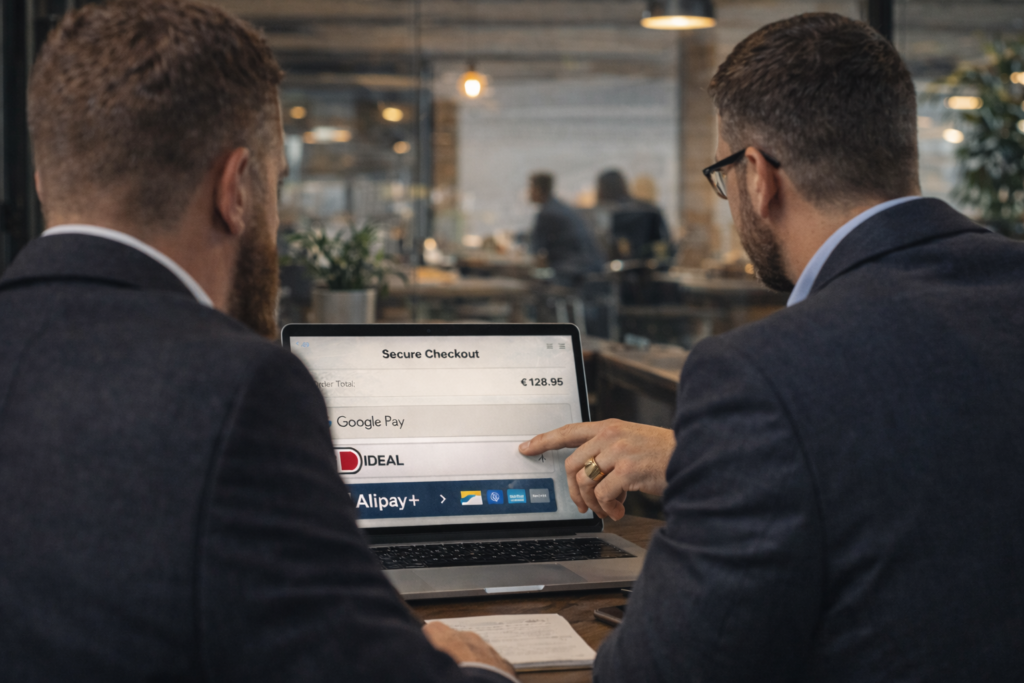
Activating a new payment method is a business decision, not a technical one
Starting with Customer Needs, not feature lists
The process of selecting and integrating payment methods should always begin from genuine customer needs, not from available features or competitive mimicry. Understanding who your buyer is, what they expect from the checkout experience, and how they genuinely prefer to pay forms the essential foundation of any successful payment integration.
Unfortunately, too many merchants approach payment method selection by reviewing what their payment service provider offers in their feature catalog or by observing what competitors have implemented, then activating methods based on perceived industry trends rather than actual, demonstrated customer needs. This backward approach consistently leads to bloated checkout pages featuring numerous payment options that few customers actually use. The result is visual clutter that reduces conversion rather than improving it, creating decision paralysis and slowing down the critical final step of the purchase journey.
The right approach begins with rigorous customer research. Who are your customers, really? What payment methods do they already use confidently in their daily lives, both for ecommerce and other contexts? What specific concerns or friction points do they mention about your current checkout experience when given the opportunity to provide feedback? What abandonment patterns appear in your analytics data, where exactly do customers drop off, and does that vary by payment method or customer segment? These questions should drive payment method decisions, not feature availability checklists or competitor mimicry.
Customer segmentation reveals critically important insights for payment strategy that aggregate data obscures. A fashion retailer targeting Gen Z customers will quickly discover that buy-now-pay-later options are not just nice to have but essential and expected, their absence creates immediate competitive disadvantage. Yet that same BNPL integration might see virtually zero adoption for a B2B industrial supplies distributor whose customers are making company purchases through corporate procurement processes. The payment method that’s essential for one segment is irrelevant for another.
Geographic concentration matters tremendously and gets overlooked constantly. A merchant with significant traffic from Germany should absolutely prioritize solutions like Giropay or Sofort banking, which German customers know, trust, and use regularly. These same payment methods would be completely irrelevant for a purely domestic Italian business, where they’d add clutter without value. Yet merchants regularly activate payment methods without this geographic analysis, implementing options that look good in marketing materials but serve no actual customer need.
Understanding the customer’s mental model around different payment methods is also crucial for strategic positioning. Different payment methods carry different psychological associations that affect how customers perceive both the transaction and your brand. Bank transfers are generally perceived as more secure but less convenient. Digital wallets are seen as convenient and modern but sometimes raise privacy concerns. Buy-now-pay-later solutions signal flexibility and accessibility but can carry negative associations around debt for some customer segments. The decision to integrate a specific payment method communicates something about your brand and what you value. A luxury brand might consciously avoid certain BNPL solutions that they feel diminish product prestige or attract customers unlikely to become long-term valuable relationships, while a fast-fashion retailer embraces those same solutions as essential conversion enablers for their target demographic.
Customer feedback loops should continuously inform ongoing payment strategy rather than being consulted once during initial implementation. Regular surveys explicitly asking customers about their checkout experience, systematic analysis of customer support tickets related to payment issues, and active monitoring of social media commentary about your checkout process all provide invaluable insights that quantitative analytics alone cannot capture. The most sophisticated merchants treat payment method performance as a continuous optimization opportunity rather than a one-time implementation project—they’re constantly evaluating, testing, refining, and adapting based on evolving customer needs and behaviors.
Provider Selection: beyond price to strategic fit
Once you’ve identified which payment methods actually serve customer needs, provider selection should follow clear criteria that extend well beyond transaction pricing. Reliability, support quality, technological roadmap alignment, and scalability matter far more in the long run than marginal cost differences that look significant in spreadsheet comparisons.
The temptation to choose payment providers purely based on transaction fees is entirely understandable but profoundly shortsighted. A provider charging 0.3% less per transaction but consistently delivering subpar reliability, slow support response times, or fundamental scalability limitations will cost dramatically more in lost revenue, operational headaches, and technical debt than any fee savings could possibly provide. Yet merchants make this mistake constantly, optimizing for the visible cost while ignoring the hidden costs that dwarf it.
Reliability should be the first and most important evaluation criterion. What is the provider’s historical uptime, measured rigorously? How do they handle peak traffic periods like Black Friday or product launches? What redundancy and failover systems do they actually have in production, not just in marketing materials? Payment processing sits at the final step in the conversion funnel, any failure at this critical stage means guaranteed lost revenue, frustrated customers, and potential brand damage. A provider advertising 99% uptime sounds impressive until you calculate that this means 87 hours per year when your customers simply cannot complete purchases. For a business doing €10 million in annual revenue, that’s potentially €100,000 in lost sales, far exceeding any transaction fee savings.
Support quality varies dramatically across payment providers and directly impacts your bottom line. When payment issues arise, and they absolutely will, regardless of how robust the integration, response time and resolution quality directly impact revenue during the outage period. Providers offering genuine 24/7 support staffed by experienced technical personnel who can quickly diagnose complex issues are worth premium pricing. Those relying on slow ticket-based support systems staffed by junior representatives following troubleshooting scripts will cost you more in lost sales during extended outages than you save in transaction fees. This isn’t theoretical, payment issues during high-traffic periods have cost individual merchants hundreds of thousands in lost revenue when resolution dragged across hours rather than minutes.
Roadmap alignment represents an often-overlooked but strategically critical consideration. Payment technology evolves rapidly, with new authentication standards like Strong Customer Authentication, emerging fraud prevention techniques using machine learning, and novel checkout experiences appearing constantly. Providers who invest heavily in research and development and regularly ship new capabilities enable your business to stay current and competitive without requiring constant platform migrations. Those who maintain legacy systems and resist innovation eventually transform from assets into liabilities, forcing you into expensive, disruptive migrations when you finally can’t avoid modernization any longer.
Scalability encompasses multiple dimensions beyond simple transaction volume. Can the provider handle your current transaction volume and your projected volume three years from now? Do they support all the geographic markets you plan to enter, or will international expansion require finding new providers? Can they accommodate your specific integration requirements as your platform evolves? Will their pricing model remain economically reasonable at scale, or does it include volume tiers that become prohibitive as you grow? Many merchants have made the costly mistake of integrating a provider that works perfectly at current volume but imposes prohibitive per-transaction fees or hard technical limitations as the business scales, forcing expensive re-platforming exactly when resources should focus on growth.
The integration ecosystem surrounding a payment provider also deserves careful consideration. Providers with robust, well-maintained documentation, extensive integration partnerships with major ecommerce platforms, and active developer communities are dramatically easier to work with and offer more flexibility than those with proprietary, closed systems. The ability to seamlessly connect your payment processing to analytics tools, fraud prevention systems, accounting software, marketing platforms, and customer data platforms multiplies the value of the core payment capability. An isolated payment system that doesn’t integrate cleanly with your broader technology stack creates ongoing operational friction and limits your ability to leverage payment data for business insights.
Testing: beyond technical validation to experience validation
Testing plays an absolutely critical role that extends far beyond technical validation. Integration must certainly be validated technically, transactions must process correctly, error handling must work as designed, edge cases must be managed appropriately. But the checkout experience must also be tested end-to-end, exactly as an actual customer would experience it, because small friction points often hide in precisely the places development teams least expect them.
Technical testing typically focuses on whether transactions process successfully, whether error states trigger appropriate handling, and whether edge cases like network interruptions or unusual input values are managed correctly. This is necessary but entirely insufficient. Payment integrations can pass every technical test while still delivering poor customer experiences that significantly damage conversion rates.
End-to-end experience testing should be conducted by people who haven’t worked on the integration and don’t understand the system’s internal architecture. Give them realistic scenarios “purchase this product using Apple Pay from an iPhone” and carefully observe where they encounter confusion, hesitation, or friction. The interaction patterns that seem completely obvious to the development team who built the feature are often unclear or confusing to actual customers encountering it for the first time. This testing frequently reveals UX issues that technical testing never surfaces: unclear button labels, confusing state transitions, inadequate loading indicators, error messages that don’t actually help users resolve problems.
Device and browser testing is essential given the fragmentation of the modern web ecosystem. Payment experiences that work perfectly on desktop Chrome can break catastrophically on mobile Safari or exhibit subtle but conversion-damaging issues in less common browsers like Samsung Internet. Given that mobile commerce frequently exceeds 50% of total traffic for many merchants, mobile payment experience testing deserves particular attention and resources. Testing must happen on actual devices, not just browser emulators, because payment method behavior, particularly for wallet integrations and biometric authentication, can differ significantly between emulated and real environments.
Network condition testing reveals important issues that only appear under real-world conditions. Payment processing should gracefully handle slow connections, network interruptions, and request timeouts. Test specifically how your integration behaves when network conditions degrade significantly, does it provide clear, actionable feedback to customers about what’s happening? Does it prevent duplicate charges if an impatient customer clicks “pay” multiple times during a slow connection? Does it recover gracefully and preserve customer progress when connections resume? These scenarios happen constantly in real usage and cause significant conversion damage when handled poorly.
Accessibility testing ensures that all customers can complete payments regardless of disability, which is both an ethical imperative and a legal requirement in many jurisdictions. Can the entire checkout flow be navigated using only a keyboard, without requiring a mouse? Does it work correctly with screen readers used by blind customers? Are error messages communicated clearly through multiple channels, not just visually? Are color contrasts sufficient for customers with visual impairments? Payment experiences that fail accessibility standards not only exclude potential customers and damage brand reputation but also expose businesses to legal liability in jurisdictions with accessibility requirements.
Cross-payment method testing becomes crucial when multiple payment options are available. How does the experience work when customers switch between payment methods mid-checkout? Are payment method selection states preserved if a customer navigates away from the checkout and later returns? Do all methods display consistently regardless of order total, customer location, items in cart, or customer account status? Inconsistent behavior across different payment methods creates confusion and abandonment, customers lose confidence when the checkout experience changes unpredictably based on their payment choice.
Security testing must extend well beyond technical penetration testing to include social engineering scenarios and fraud pattern testing. Can malicious actors manipulate payment flows to their advantage? Are there opportunities for card testing attacks where fraudsters validate stolen card numbers? Does the system properly detect and respond to suspicious transaction patterns? Payment security failures can be absolutely catastrophic for businesses, resulting not just in direct financial losses but also in processor account termination, regulatory penalties, and severe brand damage.
Data: the ultimate arbiter of payment method value
Finally, data provides the ultimate, definitive verdict on whether a payment method delivers genuine business value. Conversion rates, drop-off points, average order value, customer acquisition costs, and repeat purchase behavior reveal whether a payment method truly delivers on its promise or simply adds complexity without corresponding benefit.
After implementing a new payment method, rigorous measurement becomes absolutely critical. The goal extends beyond simply tracking adoption rates, how many customers used the new payment option, to understanding how the payment method affects overall business metrics. Does it increase total conversion by enabling purchases from customers who would otherwise abandon, or do existing customers who would have purchased anyway simply switch to the new method? Does it reduce cart abandonment rates at checkout? Does it attract genuinely new customer segments or just redistribute existing customers across payment options?
Segmented analysis provides dramatically deeper insights than aggregate metrics alone. A payment method might show mediocre overall performance while excelling with specific, valuable customer segments. Buy-now-pay-later solutions frequently show this pattern, relatively low overall adoption rates but very high usage rates among younger customers and for higher-value purchases where the financing aspect matters most. Understanding these nuanced patterns enables much more sophisticated decisions about how to position, promote, and optimize different payment options for different contexts.
Drop-off analysis reveals precisely where payment method integrations succeed or fail in practice. If customers consistently select a particular payment method but then frequently abandon before completing the transaction, that clearly signals UX issues, trust problems, or technical friction that needs immediate addressing. Comparing drop-off rates across different payment methods highlights which provide the smoothest, most confidence-inspiring experiences and which create unnecessary obstacles.
Average order value analysis can uncover interesting and commercially valuable payment method effects. Buy-now-pay-later solutions typically increase AOV substantially because they reduce price sensitivity for larger purchases-customers comfortable spending €150 might spend €300 when offered interest-free installments. Conversely, some digital wallets can decrease AOV because they dramatically reduce friction for impulse purchases, enabling many smaller transactions. Understanding these dynamics helps merchants optimize which payment methods to actively promote for which product categories, price points, or customer segments.
Repeat purchase behavior provides crucial insights into long-term payment method value that single-transaction metrics miss entirely. Payment methods that enable saved credentials and true one-click checkout typically correlate with significantly higher customer lifetime value because they reduce friction for all subsequent purchases. Methods requiring re-authentication or re-entry of payment information for each purchase create recurring opportunities for customers to reconsider their purchase, comparison shop, or simply abandon-small friction that compounds dramatically over time.
Cost analysis must account for far more than visible transaction fees. Some payment methods impose fixed monthly fees regardless of volume, ongoing compliance costs, integration maintenance expenses, or fraud liability costs that significantly impact their total cost of ownership. A payment method with slightly higher transaction fees but lower fraud rates and minimal operational overhead might deliver far better economics than one with lower headline fees but higher hidden costs. A holistic view of payment method costs relative to the revenue they enable provides the only accurate picture of return on investment.
A/B testing enables rigorous, scientific payment method evaluation. Rather than simply activating a new payment method for all customers simultaneously and hoping for the best, test it with a controlled subset and compare results to a control group continuing with existing options. This isolates the specific impact of the new payment method from the dozens of other variables constantly affecting conversion rates, seasonality, marketing campaigns, product mix changes, competitive dynamics. Progressive rollouts based on test results minimize risk while still enabling innovation and learning.
The Strategic Imperative: process over technology
The fundamental difference between a random, ineffective payment integration and a genuinely conversion-driving project lies entirely in process discipline, not in technology selection. The exact same payment method integration can succeed brilliantly or fail completely based entirely on how thoughtfully it’s implemented, measured, and optimized.
Merchants who treat payment method activation as a strategic business initiative, starting from genuine customer needs, selecting providers based on strategic fit rather than just pricing, testing comprehensively across the full experience, and measuring rigorously against business objectives, consistently see meaningful conversion improvements and sustainable competitive advantages. Those who treat it as a technical checkbox to be completed and forgotten waste precious resources on integrations that sit essentially unused or, worse, actively harm conversion by cluttering checkout pages and creating confusion.
The most successful merchants develop comprehensive payment strategy frameworks that guide ongoing decisions about which methods to integrate when, when to deprecate underperforming options that add complexity without value, and how to continuously optimize the overall payment experience. These frameworks treat payments as a core competency of digital commerce rather than a commodity infrastructure layer to be minimized and ignored. In an era where even small conversion rate improvements compound to significant revenue impacts, a 2% conversion improvement for a €10 million business means €200,000 in additional annual revenue, this strategic approach to payment method management increasingly separates category leaders from laggards.